
























01
Intermittent signal loss
Tunnel exits / urban canyons
Insufficient sensitivity can cause signal loss in weak-signal scenarios such as tunnel exits and urban canyons, leaving users temporarily without navigation guidance.


Testing capabilities last verified: September 21, 2026
Satellite navigation now underpins transportation, logistics tracking, smart cities, and personal devices. When a receiver underperforms, position drift, repeated signal loss, and slow response translate directly into returns and customer complaints. Allion’s GNSS signal simulation testing helps you quantify key risks in time to first fix, accuracy, and sensitivity before your product ships.
Allion’s GNSS performance testing service is delivered by our RF Test Lab, which uses an R&S SMBV100B signal simulator to recreate satellite signals in an anechoic chamber and measure a product’s time to first fix (TTFF), acquisition and tracking sensitivity, reacquisition time, and positioning accuracy. Results can be benchmarked side by side against Allion’s internal reference module, and we can also measure how coexistence interference affects positioning while LTE and Wi-Fi are running at the same time.
Our standard configuration supports GPS L1, Galileo E1, and BeiDou B1; GLONASS, QZSS, NavIC, and the L2/L5 bands can be added on a per-project basis, with both OTA and conducted testing available. The service applies to any product with a built-in GNSS receiver, including automotive head units, dash cams, handheld devices, wearables, navigation devices, IoT trackers, drones, and industrial handhelds.
GNSS covers satellite navigation systems including the US GPS, Russia’s GLONASS, China’s BeiDou, and the EU’s Galileo. It is widely used in vehicle navigation, rail dispatching, maritime positioning, drone flight control, and personal device location, as well as in time-synchronization applications such as financial timing and intelligent transportation. Receiver performance can be affected by weather, signal refraction, building obstruction, interference sources, and hardware and software quality.
Tunnel exits / urban canyons
Insufficient sensitivity can cause signal loss in weak-signal scenarios such as tunnel exits and urban canyons, leaving users temporarily without navigation guidance.
Position offset / route mismatch
When the receiver picks up erroneous or offset position signals, the navigation route may not match the actual path, undermining driving decisions and the accuracy of logistics tracking.
Signal feedback / repositioning
When signal feedback and repositioning are too slow, users may not receive navigation information in time, increasing the risk of wrong turns.
Any product with a built-in GNSS receiver can have its positioning performance validated through this service. Common applications include:
| Product Category | Typical Products |
|---|---|
| Automotive head units / IVI | Center-console navigation displays, in-vehicle infotainment systems, and aftermarket head units. |
| Dash cams | Front and rear dash cams with GPS track logging. |
| Handheld devices | Smartphones, tablets, handheld GPS navigators, and survey data collectors. |
| Wearables | GPS sports watches, smart bands, and kids’ GPS watches. |
| Motorcycle / bicycle navigation | Motorcycle navigation devices, bike computers, and other GNSS-enabled mobile devices. |
| IoT trackers | Asset trackers, pet trackers, and logistics tracking modules. |
| Small drones | Consumer and commercial drones. |
| Outdoor / industrial handhelds | Rugged handheld terminals, agricultural and forestry survey equipment, and other outdoor positioning devices. |
DUT size limit: OTA testing requires placing the product in an anechoic chamber, which accommodates devices up to approximately 1 m × 1 m × 1 m. For larger equipment, please ask about our conducted testing option.
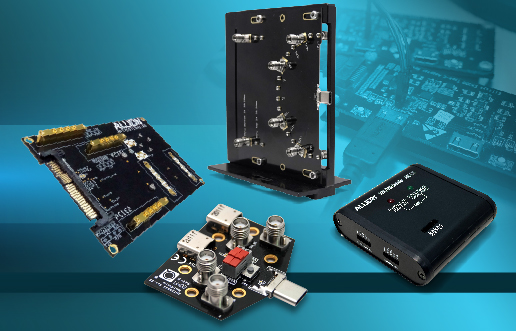
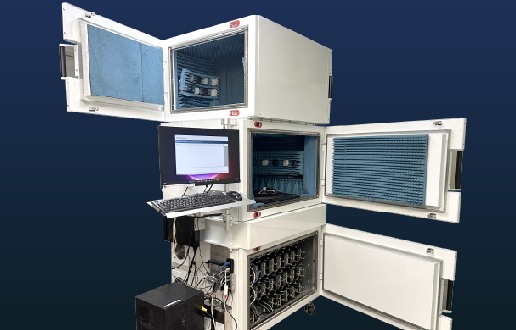
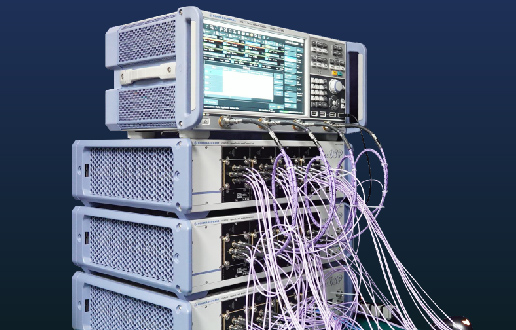
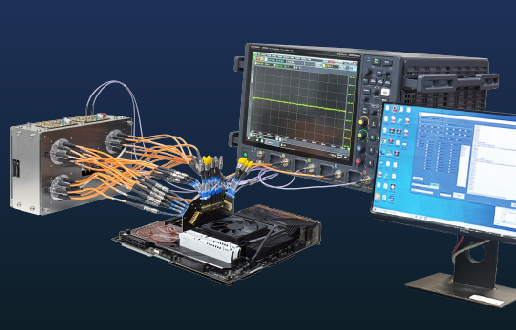
Allion pairs an R&S SMBV100B signal simulator with an anechoic chamber to create a controllable, repeatable RF test environment, using a control PC to set test conditions and capture data from the device under test. For coexistence testing, an R&S CMW500 is used to establish the LTE connection.
| Equipment / Environment | Purpose |
|---|---|
| GNSS signal simulator (R&S SMBV100B) | Simulates multiple constellations, power levels, satellite counts, and dynamic trajectories to recreate a wide range of usage scenarios. |
| Wireless communication tester (R&S CMW500) | Establishes an LTE connection with controlled signal quality and, combined with a Wi-Fi load, enables GNSS coexistence interference testing. |
| Anechoic chamber | Isolates external RF signals and electromagnetic interference for more repeatable, consistent test results. |
| Control PC | Controls the simulator, captures EUT feedback data, and supports test operations such as clearing ephemeris data. |
| Conducted testing | Suited to development stages before antenna integration is complete, or for products too large for the OTA chamber. |
Scroll horizontally to see the full table
The R&S SMBV100B can simulate the satellite systems and bands below. Items marked “Standard” are part of the lab’s fixed configuration; all others are project-based configurations that can be arranged on request, with both OTA and conducted testing available.
| Constellation | L1 Band~1575 MHz | L2 Band~1227 MHz | L5 Band~1176 MHz |
|---|---|---|---|
| GPS | C/A, P, L1CStandard | C/A, P, L2C | L5 |
| Galileo | E1 OSStandard | E6 | E5a, E5b |
| GLONASS | C/A, CDMA L1 | C/A, CDMA L2 | CDMA L3 |
| BeiDou | B1I, B1CStandard | B3I | B2I, B2a, B2b |
| QZSS | C/A, L1C | L2C | L5 |
| NavIC | — | — | SPS |
Scroll horizontally to see the full table
OTA and conducted testing cover 1164–1610 MHz. Project-based configurations require additional equipment scheduling, so please specify your target constellations and bands when requesting a quote.
Signal simulation recreates satellite signal scenarios under different environmental conditions early in product development, reducing reliance on field road tests. Allion covers four testing areas:
TTFF · Reacquisition Time
Verifies cold, warm, and hot start performance, as well as how quickly the receiver regains a fix after signal blockage.
Static · Dynamic Accuracy
Quantifies the receiver’s coordinate error at a fixed position and along a moving trajectory.
Acquisition · Tracking Sensitivity
Determines the minimum power threshold at which the receiver can obtain a fix and maintain tracking in weak-signal environments.
LTE · Wi-Fi Coexistence
Uses an R&S CMW500 to establish an LTE connection while applying a Wi-Fi load, measuring how much the product’s own radios desensitize GNSS reception.
Signal simulation precisely controls satellite count, signal strength, and constellation mix to reproduce identical conditions in the lab, completing a single testing scope in about 3–4 working days.
| Criterion | Field Road Test | Signal Simulation | Benefit |
|---|---|---|---|
| Testing timeline | 5–7+ days, subject to weather and site availability | About 3–4 working days | Roughly half the time |
| Variable control | Weather, satellite positions, and surrounding interference can’t be controlled | Satellite count, power, and constellation can each be set individually | Issues can be traced to a single variable |
| Repeatability | Conditions differ every time | The same scenario can be rerun | Direct before-and-after comparison of design revisions |
| Weak-signal threshold | Signal strength can’t be controlled | Stepped down in dB increments | Quantified sensitivity gaps |
| Single-constellation testing | Hard to isolate one constellation from mixed signals | Any single constellation can be enabled on its own | Pinpoints per-constellation performance gaps |
Scroll horizontally to see the full table
If you also need validation under real road conditions, pair this service with our In-Country Road Test Consulting Program.
Testing covers three areas: timing performance, sensitivity, and positioning accuracy.
| Category | Test Item | What It Measures |
|---|---|---|
| Timing performance | TTFF — Cold Start | Time from power-on to first fix with no satellite data available. |
| TTFF — Warm Start | Time to regain a fix when approximate position and time are known but ephemeris data has expired. | |
| TTFF — Hot Start | Time to quickly reacquire a fix when valid ephemeris and position data are still available. | |
| Reacquisition Time | Time to recover a fix after the signal is blocked. | |
| Sensitivity | Acquisition Sensitivity | Lowest signal strength at which a first fix can be obtained. |
| Tracking Sensitivity | Lowest signal strength at which tracking can be maintained after a fix. | |
| Positioning accuracy | Static Navigation Accuracy | Offset between the reported coordinates and the set position while stationary. |
| Dynamic Navigation Accuracy | Position error and path-following performance along a simulated moving trajectory. |
Scroll horizontally to see the full table
Disclaimer: This is a product performance testing service, not regulatory compliance or certification testing. The standards below are referenced only to define test items and measurement methods. Allion does not perform formal compliance testing against them or issue certification reports.
| Standard | Organization | What This Service References |
|---|---|---|
| 3GPP TS 37.571-1 | 3GPP | Definitions of positioning performance items such as sensitivity and TTFF |
| CTIA OTA Test Plan (GNSS section) | CTIA | Concepts for OTA GNSS performance measurement of mobile devices |
| ETSI EN 303 413 | ETSI | Scope of EU RED requirements for GNSS receivers |
Scroll horizontally to see the full table
Below are results from an automotive information display terminal measured simultaneously with Allion’s internal reference module under identical conditions. The terminal’s tracking and acquisition sensitivity were 8 dB worse than the reference module, mainly due to shielding and impedance mismatch from the enclosure. Testing the terminal on its own would never have revealed this loss.
Tracking and acquisition sensitivity loss vs. reference module
Slower cold-start TTFF than reference module (45 vs. 36 s)
Static position error (reference module: 0 m)
Case: Automotive information display terminal vs. Allion internal reference module (GPS L1, 6 visible satellites)
| Test Item | Automotive Display Terminal | Allion Reference Module |
|---|---|---|
| TTFF (s) | ||
| Cold Start | 45 | 36 |
| Warm Start | 29 | 34 |
| Hot Start | 3 | 2.3 |
| Positioning accuracy (m) | ||
| Static | 5 | 0 |
| Moving | 1 | 1 |
| Sensitivity (dBm) | ||
| Tracking Sensitivity | −127.25 | −135.25 |
| Acquisition Sensitivity | −118.25 | −126.25 |
| Other (s) | ||
| Reacquisition Time | 2 | 2.5 |
Scroll horizontally to see the full table
For the full case analysis, see What GNSS Datasheets Don’t Tell You: Real-World Positioning Blind Spots in Automotive, Handheld, and IoT Devices.
From receiver performance measurement and raw data analysis to test planning for each stage of development, Allion helps you understand the real-world performance of your GNSS receiver before launch.
Signal simulation testing quantifies time to first fix, accuracy, and sensitivity under different power levels, satellite counts, and dynamic conditions.
We capture and log raw EUT positioning data and compare it point by point with reference coordinates to help you identify position-error trends and outlier jumps.
From module selection and conducted testing during design to OTA testing of the finished product, we offer the right solution at each stage of the product lifecycle.
| Item | Details |
|---|---|
| Timeline | Typically 3–4 working days from sample receipt to report, depending on testing scope |
| Samples | 2 units recommended (1 primary, 1 spare); minimum 1 unit |
| What you provide | A tool or command interface for controlling the DUT that can trigger a fix, clear ephemeris data, report fix status, report C/N₀ or RSSI, and output NMEA logs |
| Report contents | Raw measurement data for each item, comparison with the reference module, and root-cause analysis and improvement recommendations for any anomalies |
| Project configuration | Constellations and bands outside the standard configuration require additional equipment scheduling; please let us know when you contact us |
Below are representative issues uncovered during GNSS testing, covering automotive, industrial handheld, IoT, and telecom CPE products.
| Product Type | Issue Found | Key Data | Full Article |
|---|---|---|---|
| Automotive information display | Sensitivity loss from enclosure shielding | 8 dB worse than reference module | What GNSS Datasheets Don’t Tell You |
| Industrial handheld tool | Galileo performance far below GPS | Cold start: 184 s vs. 26 s | What GNSS Datasheets Don’t Tell You |
| IoT Gateway | Dynamic positioning accuracy gap | 5 m vs. 1 m for reference module | What GNSS Datasheets Don’t Tell You |
| Japanese telecom CPE | LTE Band 3 coexistence desense | Accuracy rate: 90% → 0–10% | How Do You Test LTE–GNSS Coexistence Interference? |
Scroll horizontally to see the full table
Our standard configuration supports GPS L1, Galileo E1, and BeiDou B1. GLONASS, QZSS, NavIC, and the L2/L5 bands can be added on a per-project basis, with both OTA and conducted testing available.
Yes. The DUT and Allion’s internal reference module are measured simultaneously under identical signal conditions, comparing TTFF, sensitivity, and positioning accuracy item by item to quantify losses from enclosure shielding and antenna efficiency.
Yes. We use an R&S CMW500 to establish an LTE connection while applying a 2.4 GHz Wi-Fi load, measuring how much the product’s own radios desensitize GNSS positioning. We have already completed this testing for a CPE device for a Japanese telecom operator.
Typically 3–4 working days, depending on testing scope. We recommend 2 samples (primary and spare), with a minimum of 1.
Yes. Conducted testing measures the module directly; once the full product is assembled, OTA testing follows. The difference between the two shows the loss caused by the enclosure and antenna.
The number alone is hard to interpret, so we recommend comparing it with a reference module under the same conditions. For example, one automotive terminal measured −127 dBm tracking sensitivity, and only after benchmarking did it become clear that it was 8 dB worse than the reference module.
Yes. By lowering signal strength, simulating signal interruptions, and setting moving trajectories, we can recreate weak-signal conditions, tunnel exits, and positioning while in motion.
No. This is a performance testing service and does not include regulatory compliance testing. For market compliance, please contact an accredited certification laboratory.
Contact Allion and we’ll design a GNSS testing plan tailored to your product type, development stage, and target test items.