



































With decades of deep involvement in the audio-visual display ecosystem and over 30 years of proven service experience, Allion firmly believes that true consulting goes beyond simply assisting clients with application procedures. Instead, effective consulting should help eliminate potential regulatory and supply chain risks at the very beginning of the product development cycle.
HDCP Certification InquiryIn the development of digital imaging and display products, meeting technical specifications is only the baseline. What truly determines whether a product can enter mass production and be shipped on schedule is often association membership, licensing, and regulatory compliance. For products adopting image transmission interfaces such as HDMI and DisplayPort, possessing valid HDCP membership is a critical prerequisite that cannot be overlooked.
Many manufacturers focus heavily on hardware design and functional implementation during the early stages of product development, while underestimating the potential risks associated with association membership and licensing requirements. If it is only discovered in the middle or later stages of development that the appropriate membership has not been obtained, the consequences can range from disruptions in chip procurement to serious intellectual property infringement issues—ultimately resulting in products being held at customs or forced delays in market launch, despite significant development investment.
What Is HDCP—and Why Is Membership So Critical?
HDCP (High-Bandwidth Digital Content Protection) is a content protection mechanism developed by Intel. Its primary purpose is to ensure that digital video and audio data transmitted via interfaces such as HDMI and DisplayPort is protected against unauthorized interception and copying.
For end display devices, audio-video playback equipment, industrial display systems, and embedded platforms, any product involving the transmission of protected content must comply with HDCP specifications. In practice, this means that manufacturers without HDCP membership are unable to legally obtain HDCP-enabled chipsets or Device Keys, which directly impacts product development timelines and mass production schedules.
Client Case Study: Not a Technical Issue, but “Not Knowing Where to Start”
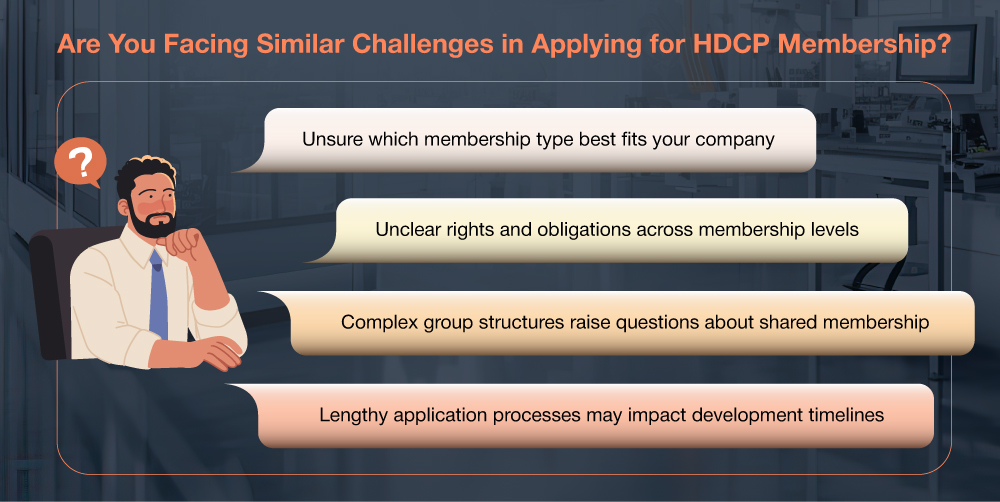
Based on real client case, there have been cases where clients were unable to obtain HDCP membership, resulting in obstacles during the chip procurement phase. To address this issue as quickly as possible, the client consulted Allion for guidance on how to correctly and efficiently acquire HDCP membership.
This issue is shared by many other clients—not because they are unwilling to join the association, but because they are unsure how to proceed. The more concerning part is that if these questions are not clarified early in the development phase, they are highly likely to evolve into significant risks during the later stages of the project.
Allion Solution: HDCP Certification Consulting
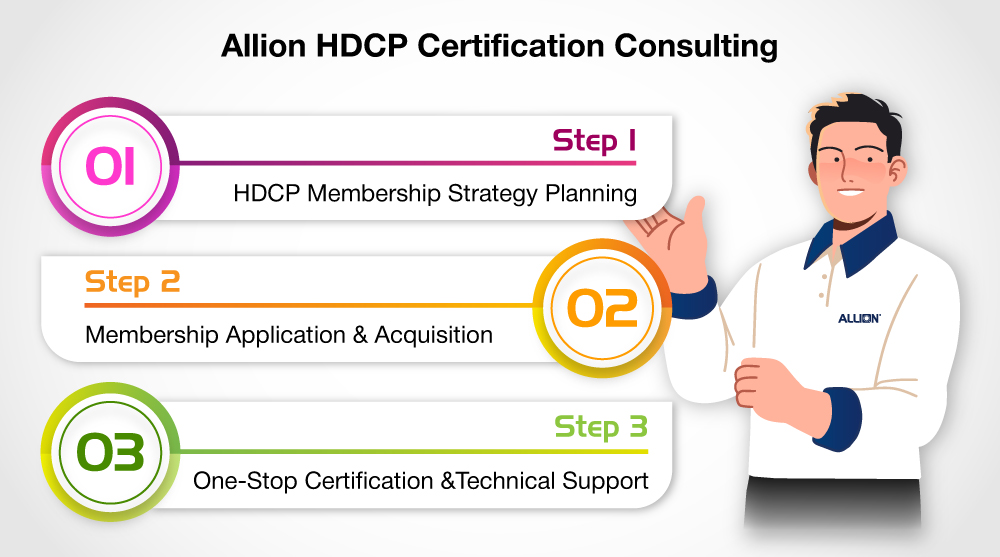
Step 1. HDCP Membership Strategy Planning
Before joining the HDCP Association, the most critical first step is not simply filling out application forms, but determining the membership type that best fits your company. Allion helps clients clarify the following key points prior to application. By confirming requirements early, companies can avoid the risk of choosing an incorrect membership type later, which could result in unnecessary reapplication, wasted time, and additional costs.
- Is there a need to procure Device Keys?
- Will the product involve the production or sale of End Products?
- Will the chosen membership type affect future product line expansion flexibility?
- Do the membership fees and benefits align with the company’s operational model?
For group companies, sharing membership can effectively reduce fees. However, in practice, if subsidiaries must communicate with the association through the parent company, this can increase communication time and uncertainty. Allion assists clients in balancing cost, efficiency, and management flexibility. Key evaluation points include:
- Do the parent and subsidiary companies meet the association’s criteria for a “subsidiary” (e.g., ownership or control)?
- Can subsidiaries share membership with the parent company?
- What are the potential advantages and limitations of a shared membership arrangement?
Step 2. Membership Application & Acquisition
Beyond strategic planning, Allion also supports clients throughout the actual HDCP Association membership application process. By facilitating smooth communication with the association, we help clients obtain membership in the shortest possible time, ensuring that ongoing product development and market launch plans remain on schedule.
Step 3. One-Stop Certification & Technical Support
Allion’s services go beyond assisting with a single association application. We provide comprehensive, one-stop certification testing and consulting services:
- Early Certification Stage: Membership and licensing strategy planning
- Early Development Stage: Product design, specification verification, and testing guidelines
- Mid-Development Stage: Planning and execution of key preliminary verification items
- Late Development Stage: Certification testing, issue analysis, and debugging support
The Value of Professional Consulting: Eliminating “Invisible Risks”
Allion paves the way for your product’s success.
In the digital display and audio-visual product sector, HDCP membership is often not a topic familiar to technical teams, yet it can be a critical factor in whether a product can be successfully mass-produced and shipped. At every key stage from development to mass production and market launch, Allion’s one-stop consulting services help clients overcome obstacles efficiently, accurately, and securely, becoming a trusted technical partner in navigating international association requirements and product compliance.
If you have any testing, validation, or consulting needs, please contact us via our inquiry form. Allion is ready to provide a tailored solution that helps your product stand out in today’s competitive market.