























100BASE-TX remains widely used in industrial equipment, embedded systems, and EV charging stations. Compliance with IEEE specifications directly impacts connectivity stability, communication distance, and system interoperability. In EV charging infrastructure, Ethernet continuously supports backend management, status reporting, firmware updates, and EMS data exchange. Rigorous 100BASE-TX electrical validation before mass production is therefore an essential milestone for ensuring product reliability and field performance.
100BASE-TX Testing: Test Items, Conditions, and Limitations
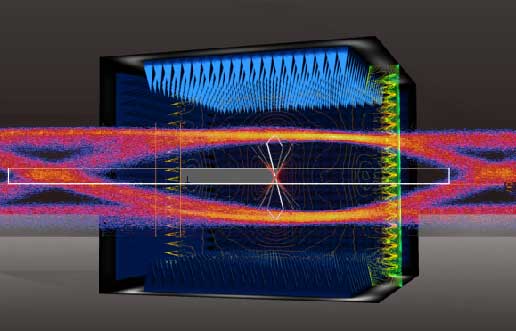
According to standard validation procedures, 100BASE-TX electrical compliance testing requires a Test Mode Command to place the DUT’s PHY into specific test patterns, enabling accurate measurement of key parameters such as Amplitude, Rise/Fall Time, Duty Cycle Distortion, and Jitter.
In practice, however, teams frequently encounter this limitation during early development stages or within customized system environments. Incomplete firmware, insufficient tooling, or system architectural constraints can all prevent the Test Mode command from being executed, blocking the PHY from generating the test patterns needed for compliance measurement. (e.g., the Scrambled Idle pattern required for 100BASE-TX compliance testing).

Success Story
The Challenge: An EV Charging System Without Test Mode Access
During the validation phase of an EV charging system, the customer was unable to provide the necessary Test Mode command due to unfinished firmware and software architecture constraints. Without access to standard test patterns, the conventional electrical validation flow could not be executed, posing risks to both development progress and production schedules.
Without access to standard test patterns, the conventional electrical validation flow could not be executed, posing risks to both development progress and production schedules.
The customer’s challenge extended beyond the absence of a test command:
1. No Stable Signal Trigger
If the Ethernet PHY does not detect a Link Partner, it typically enters idle or power-saving mode. In this state, oscilloscopes cannot capture continuous, analyzable waveforms.
2. No Specification-Required Pattern
100BASE-TX electrical measurements must be performed under defined transmission conditions. Without software intervention, the PHY will not automatically switch to the required signal state.
3. Project Timeline at Risk
If firmware or tools are not ready, hardware teams—even with full measurement capability—cannot generate valid test data, potentially delaying the entire project.
Such issues are common in embedded and industrial applications. Without an alternative validation method, teams are often forced to wait passively for software readiness.
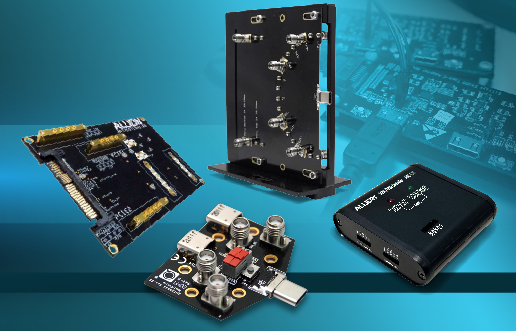
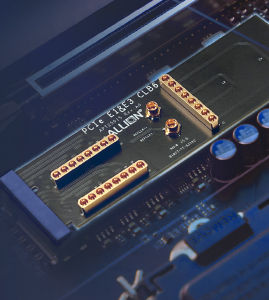
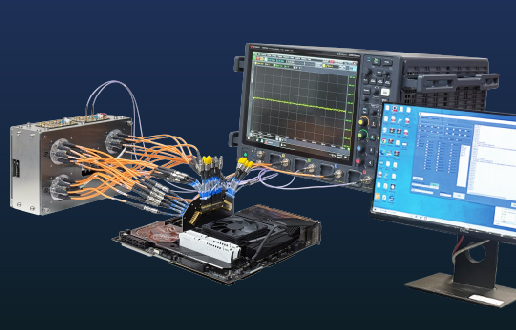
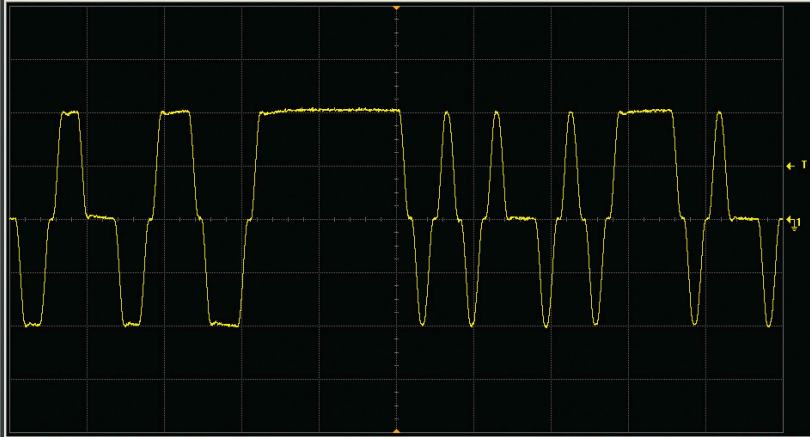
To resolve the limitation of unavailable Test Mode commands, Allion develops a customized validation strategy utilizing dedicated test fixtures and an external Link Partner device. This approach successfully bypassed software dependency and enabled physical-layer signal measurement under real operating conditions.
This approach enabled practical, standards-compliant 100BASE-TX electrical validation—without modifying system software and without entering Test Mode.
Decoupling Hardware Validation from Software Maturity
Through this solution, Allion delivered tangible benefits:
• Eliminated heavy reliance on Test Mode commands and software tools
• Enabled early PHY electrical validation even when firmware or drivers were incomplete
• Significantly reduced debug time and overall project schedules
• Provided measurement results closer to real-world operating conditions, helping uncover potential signal integrity risks earlier
Standard test procedures describe ideal validation conditions. In reality, development environments are constrained by system limitations and tight project timelines. Waiting for “perfect conditions” is often not an option.
With deep expertise in Ethernet behavior and extensive hands-on validation experience, Allion helps customers complete reliable, standards-compliant 100BASE-TX electrical validation—even in the absence of Test Mode access.
Moving forward, Allion will continue leveraging advanced measurement capabilities and problem-oriented consulting strategies to help customers overcome validation bottlenecks—ensuring product quality and development progress move forward together, and serving as a trusted technical partner in high-speed interface and networking technologies.