























As Bluetooth becomes widely adopted across consumer electronics, industrial equipment, and smart devices, Bluetooth has become a critical step before products enter the market. In recent years, the Bluetooth SIG has continuously updated its qualification procedures and requirements.
Qualification Program Reference Document
Starting in July 2024, the Bluetooth SIG officially implemented the new Qualification Program Reference Document (QPRD) v3, followed by an update to QPRD v4 in July 2025. These updates have significantly increased the initial learning curve and added risks for both new and experienced teams due to the changes in structure and operations.
Learn more
More Than a Name Change: The New Mindset Behind Bluetooth’s QPRD Update
Under the latest QPRD specifications, the Bluetooth SIG has introduced several key changes to the qualification process, including:
- Elimination of Declaration ID (DID) and Qualified Design ID (QDID)
Replaced by the new-generation identification mechanisms: Receipt Number and Design Number (DN) - Full adoption of the new online Qualification Workspace
- Revised applicability conditions and evaluation logic for Subsets
- Updated test items and applicability scope for IOPT testing
While these changes may appear to be procedural or terminological updates, they in fact reflect the Bluetooth SIG’s emphasis on design architecture accuracy and correct declaration of supported Bluetooth functionality.
Through extensive experience supporting customers with Bluetooth qualification, we have observed that the most common source of confusion is not the testing itself, but rather the evaluation logic used by the Bluetooth SIG.
Unlike many international certification schemes, Bluetooth qualification is not determined solely by the Bluetooth Core Specification version. Instead, the SIG evaluates products based on:
- Design type selection (“Specify the Design”)
- How existing qualified designs (QDID / DN) are referenced and combined
These factors determine whether testing is required, which test items apply, and how existing designs may be reused.
This qualification model exists because most Bluetooth products are not developed entirely from scratch, but instead leverage designs from chipset vendors, module suppliers, or previously qualified member designs. Additionally, Bluetooth products vary widely in terms of functionality and application scenarios.
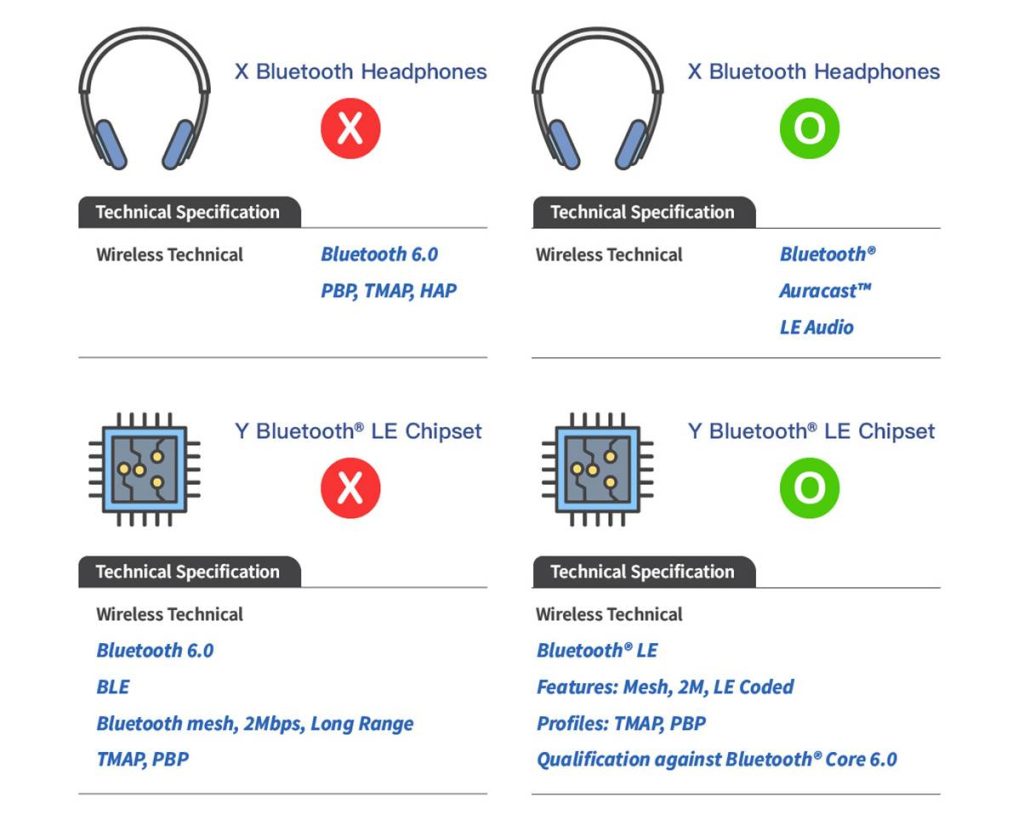
For this reason, the Bluetooth SIG has repeatedly emphasized that products should not be labeled solely by Core Specification version, but must instead accurately declare the Bluetooth features and profiles they actually support.
Unlocking Bluetooth Qualification
Specify the Design: The First Critical Decision in Bluetooth Qualification
In the Bluetooth qualification process, the Bluetooth SIG clearly defines three primary design type options, making Specify the Design the first and most critical decision point in the entire qualification workflow.
The available design type options are as follows:
Option 1: Use a Single Existing Design
Reuse one previously qualified design without modification.
Option 2: Create a New Design
- Option 2a: Create a New Design by Combining Multiple Existing Designs
A new design is created by referencing and combining multiple previously qualified designs. - Option 2b: Create Any Other New Design
A completely new design that does not rely on existing qualified designs.
Among these options, Option 2a involves particularly complex combination rules. The Bluetooth SIG only permits specific and strictly defined design combinations, and not all existing designs can be freely mixed.
Option 2a:
*Permitted Combinations
| Design 1 has | Design 2 has | Designs 3+ have (optional, additional Designs) |
|---|---|---|
| Core-Complete Configuration | X2Core Layers only | X2Core Layers only |
| Core-Controller Configuration | Core-Host Configuration | |
| Core-Controller Configuration | Core-Host Configuration | X2Core Layers only |
| Core-Host Configuration | X2Core Layers only | X2Core Layers only |
| Core-Controller Configuration | X2Core Layers implementing LC3 specification only | |
| X2Core Layers only | X2Core Layers only | X2Core Layers only |
*Permitted Combinations for Option 2a: Create a New Design that combines multiple existing Designs
If a non-permitted combination is mistakenly applied, the qualification may still proceed through testing, yet the legitimacy of the certification could later be challenged. Such risks often remain unnoticed until audits or market issues arise.
Make the Right Qualification Architecture Decision—From the Very Beginning
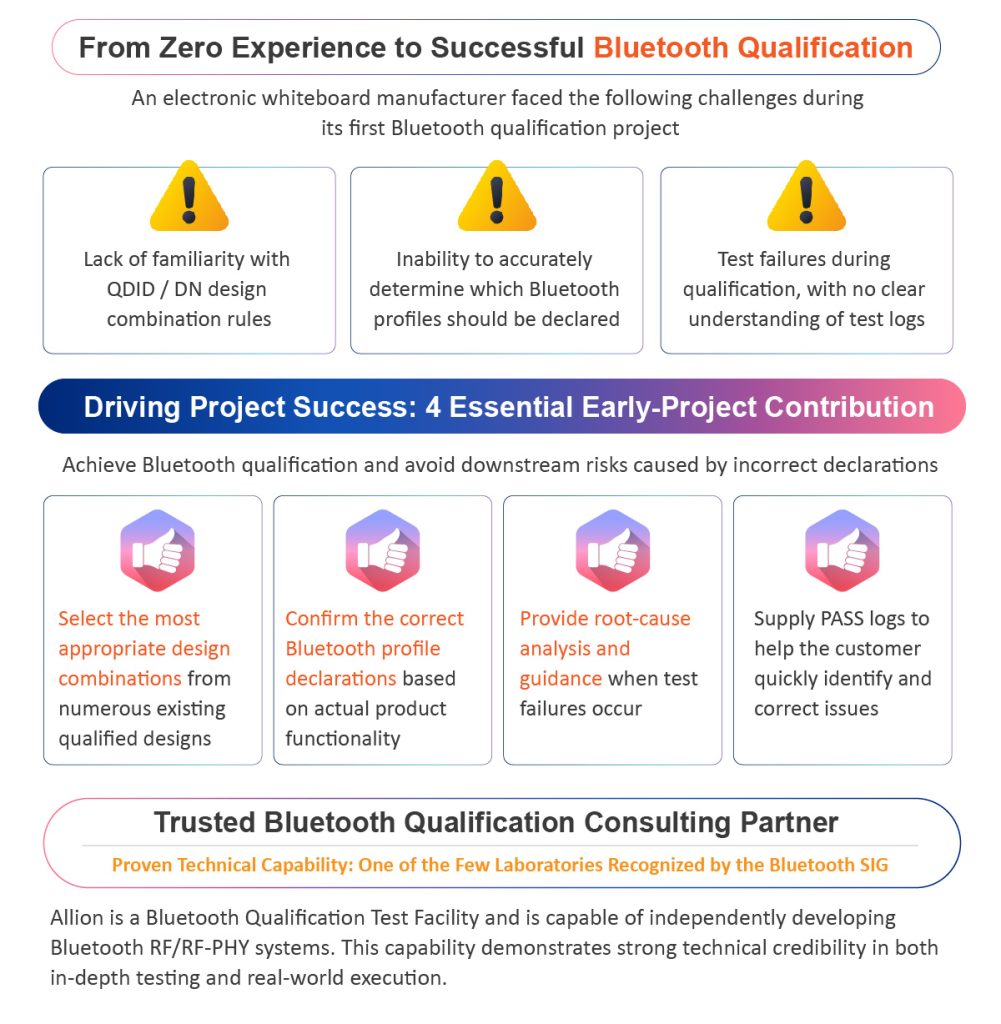
Through its consultative, architecture-level support, Allion helps first-time Bluetooth qualification teams successfully navigate even the most complex qualification frameworks—ensuring the entire process is completed under the correct certification structure from the outset.
Allion’s Bluetooth qualification consulting services include:
- Assisting in identifying the correct QDID / Design Number (DN) combinations and applicability
- Clarifying the product’s actual Bluetooth functionality and supported profiles
- Supporting Bluetooth SIG system operations, including submission workflows, fee payments, and documentation
- Assisting in responding to technical inquiries raised by the Bluetooth SIG during review
Products That Are “Qualified”—But Don’t Quite Look Right
Within the Bluetooth SIG Qualification Workspace database, it is not uncommon to find products with incomplete declarations or questionable design architectures.
For example, some LE-based mouse products declare only:
- DIS (Device Information Service)
- HIDS (Human Interface Device Service)
while failing to declare the most critical profile:
HOGP (HID over GATT Profile)
Such inconsistencies result in declarations that do not match actual product functionality. These issues typically stem from misunderstandings of Bluetooth architecture or profile usage—and may expose products to audit risks, while also negatively impacting brand credibility and perceived product quality.
Bluetooth Qualification Is Not a Paperwork Exercise—It Is a Compliance Strategy
Bluetooth qualification has never been simply about “completing tests and submitting forms.” It is a compliance engineering process that requires deep technical understanding, sound design judgment, and thorough familiarity with qualification systems.
Allion believes that truly valuable certification consulting begins before a product reaches the market—by helping customers choose the correct architecture, make accurate declarations, and avoid invisible risks.
Allion continues to leverage its professional testing expertise and in-depth understanding of qualification systems, serving as a long-term, trusted partner for customers navigating Bluetooth technology and international certification pathways.