Taking Cameras as an Example: User-Centric In-Depth Validation of Camera Experience and Peripheral Compatibility
Powered by Robotic Arms & AI Vision: No-Code Automated QA Across Camera Models and Firmware
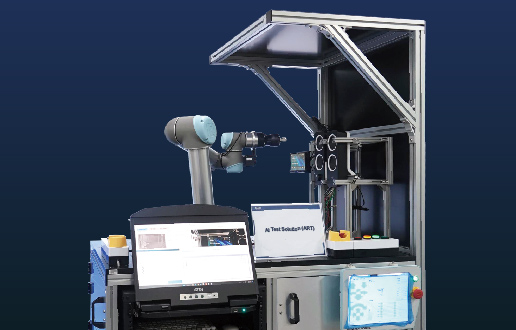
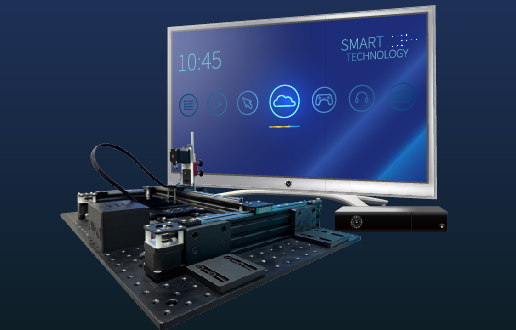
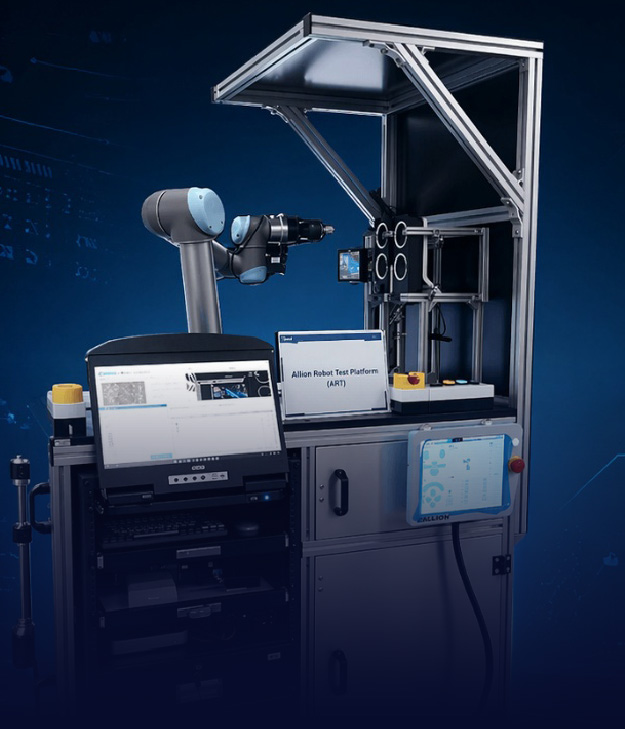
The Allion AI Robotic Test Platform (ART) combines robotic arms with AI visual recognition to automatically execute repetitive functional and peripheral-interaction tests on cameras, across multiple models. ART focuses on functional quality assurance (QA) — covering operational logic such as buttons, menus, shooting, and preview, as well as peripheral connectivity and interaction functions like Wi-Fi, Bluetooth, and companion Apps — rather than the traditional Automated Optical Inspection (AOI) used on production lines.
ART’s highly standardized architecture enables rapid deployment and easy replication across different models. When switching to a new camera model, testers simply need to swap the reference image — no script rewriting is required. ART can also integrate peripheral instruments and device control modules to automatically validate App-based remote control, cloud uploads, and cross-device connection stability. It has already been adopted by leading camera manufacturers.
Current Market Landscape: Camera Functional and Peripheral-Interaction Validation Ecosystem
Traditional camera validation relies on manually operating buttons, menus, and connectivity functions one at a time — checking only a single function point per pass. But as camera models and firmware versions update more and more frequently, validation is no longer just about whether an individual function works. It now needs to simulate the Critical User Journey, from operation to connectivity, and be executed repeatedly at scale through automation to keep pace with pre-mass-production quality gates. Yet traditional manual, single-point testing methods face the following four major challenges:
Multiple Devices × Multiple Variants Different models and variants require separate testing, increasing cost as the number of variants grows.
Image Quality Hard to Quantify Subjective judgments on clarity, sharpness, color, and restoration lead to inconsistent evaluations and a lack of standardized data.
Extensive Repeated Captures Manual key presses and captures, sample comparisons, and result checks consume time and labor, and are prone to fatigue-related human errors.
Tight Pre-Mass Production Schedule Shipping and certification timelines are tight, relying on traditional manual testing that can’t keep up with mass production pace.
Allion’s Automated Validation Solution for Smart Devices
To help camera industry customers overcome the bottlenecks of manual testing, Allion independently developed the Allion AI Robotic Test Platform (ART). Combining robotic arms with AI visual recognition, ART delivers End-to-End automated quality assurance for camera operational logic, menu functions, and peripheral connectivity, and has already been adopted by leading camera manufacturers.
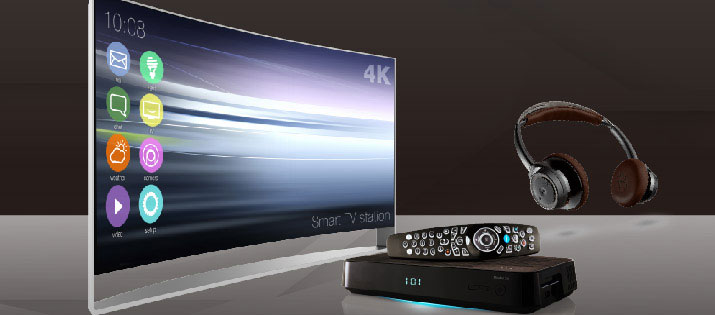
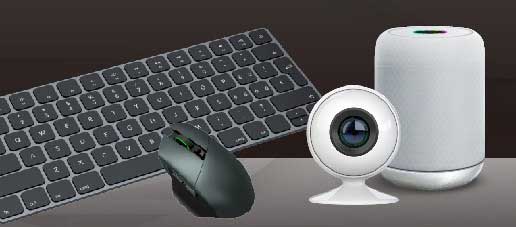
The same core architecture can also be extended to other digital electronic devices, such as smart appliances (smart locks, smart refrigerators, smart speakers) and self-service kiosks, for automated quality validation of display screens, operating interfaces, and connectivity.
Expected Benefits of Adopting ART
Improved Image Quality Automated testing enables 24/7 operation, quickly switching between models, and significantly improving efficiency.
Customer Complaints / Return Rate ↓ >50% Capture defects early through pre-shipment inspection and image analysis, reducing market complaints and customer returns.
Improved Image Quality Use classification accuracy (%) as the key metric, and replace traditional manual judgment with data-driven standards.
Higher Automation Coverage Achieve longer operation time with minimal human intervention, with 70%+ coverage, and 24/7 stable execution.
Camera Validation as the Core Use Case, One Architecture Extending Across Multiple Device Types
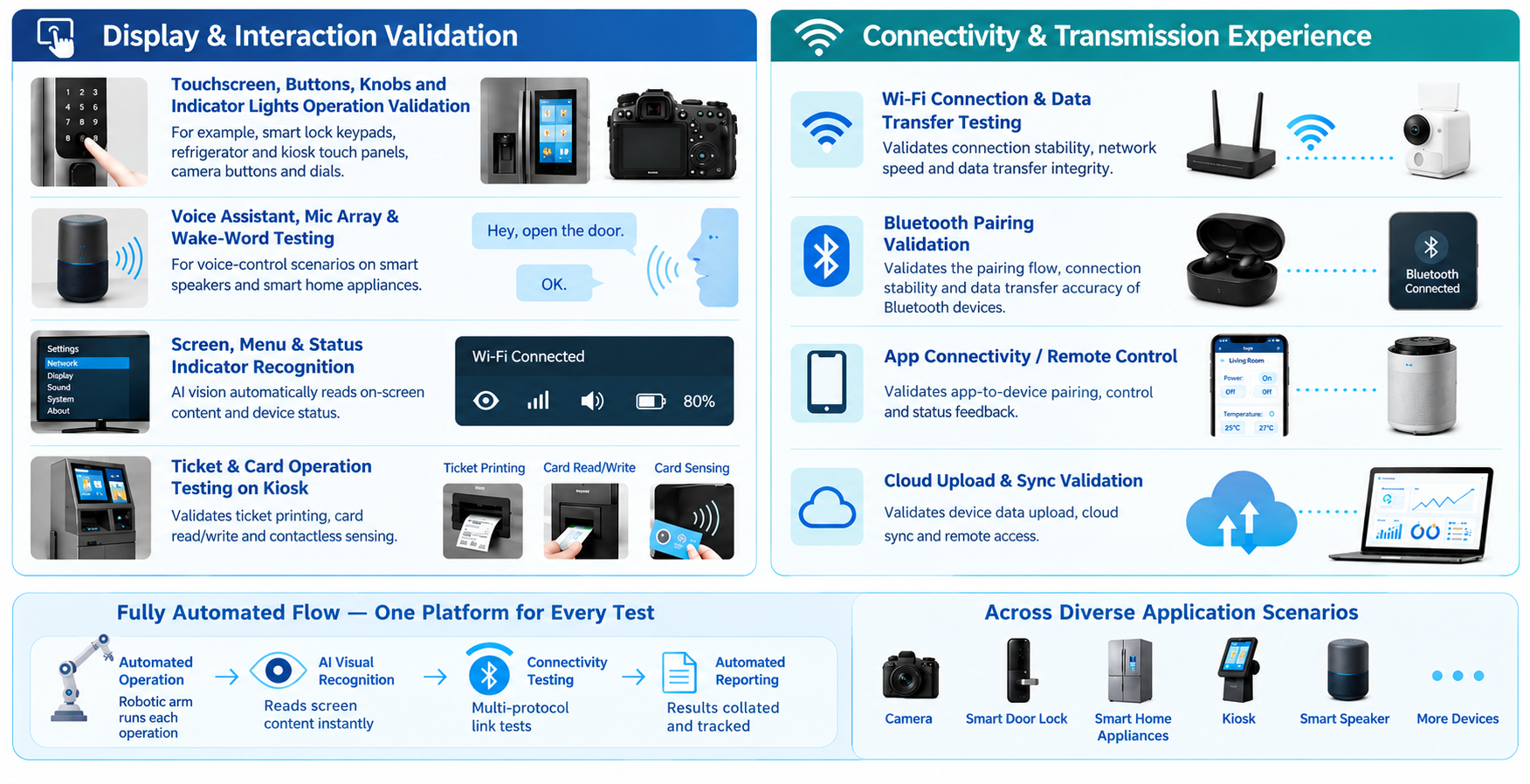
The Allion AI Robotic Test Platform (ART) integrates display and interface validation, AI visual interpretation, connectivity and data-transfer testing, and automated report generation into a single, fully automated workflow. The following uses camera validation as the core scenario, with examples of how the same approach extends to other device types.
Display and Operation Validation
Precision validation of camera controls such as the shooting mode dial, menu buttons, shutter trigger, and zoom/focus ring.
Display interpretation and validation of the preview screen, captured images, menus, and status indicators.
The same touch/button/knob operation logic can also be extended to:
Operation validation for smart lock keypads, refrigerator controls, and kiosk touch panels.
Voice assistant, microphone array, and wake-word interaction testing for smart speakers and voice-controlled smart appliances.
Ticketing and card-reader interaction validation for kiosk-type devices.
Connectivity and Data Transfer Experience
Validation of camera Wi-Fi image transfer/cloud upload, App-based remote control, and firmware/OTA updates.
Stability testing for camera Bluetooth pairing and data transfer.
This same connectivity validation architecture extends seamlessly to smart home appliances and kiosk systems for App integration, remote control, and cloud synchronization.
Validating Every Critical User Journey Across the Camera Product Ecosystem
Rather than validating isolated functions, ART verifies End-to-End User Journeys — testing how the product responds and stays connected throughout real-world usage flows, ensuring every user experience remains consistent and stable.
Lag or delayed response when switching shooting modes or navigating menus
Operating logic or menus shifting after firmware updates
What the Allion AI Robotic Test Platform (ART) Delivers
Validates the response and on-screen display of buttons, dials, touch controls, and menus, with automatic comparison across firmware versions and models.
Customer Value
Ensures a consistent operating experience and catches UI anomalies early.
Market Pain Points
Failed or slow Wi-Fi image transfer/cloud upload
Failed Bluetooth pairing or unresponsive App-based remote control
What the Allion AI Robotic Test Platform (ART) Delivers
Validates whether connections, data transfer, and remote control between the camera, App, and cloud remain stable.
Customer Value
Reduces connectivity-related customer complaints and improves cross-device compatibility.
Market Pain Points
Certain functions malfunction or become unusable after firmware updates (e.g., menus disappearing, unresponsive shutter)
What the Allion AI Robotic Test Platform (ART) Delivers
24/7 non-stop automated testing that automatically validates whether key functions continue operating correctly after OTA updates.
Customer Value
Lowers OTA regression risk and increases release confidence.
From Standard Delivery to Custom Extensions
To give customers the flexibility to adopt at their own pace, the Allion AI Robotic Test Platform (ART) offers standard automation capabilities that are ready to deliver now, plus custom services that extend to meet specific needs:
READY | What We Can Deliver Today
Robotic arm: Button/knob/touch/menu operation, such as the camera’s shooting mode dial and shutter.
AI visual recognition: Display and status interpretation.
Result consistency: Comparison across firmware versions and models.
Automated reporting: Automatic generation of results and logs.
EXTEND | Custom Extensions (Consulting Services)
Standardized fixtures: Highly standardized — a single fixture can be quickly deployed across multiple camera models.
Custom fixtures: Tailored for special models/interfaces, such as unique buttons or lens modules.
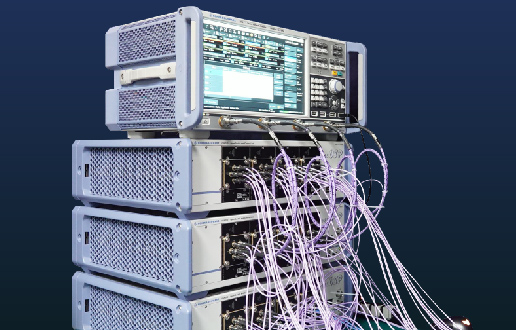
Instrument integration: Automated data capture and interpretation from peripheral instruments such as signal analyzers and power meters, supporting functional and connectivity-stability validation.
Build once, replicate fast: Once standardized, the setup can be replicated across multiple models or product lines.
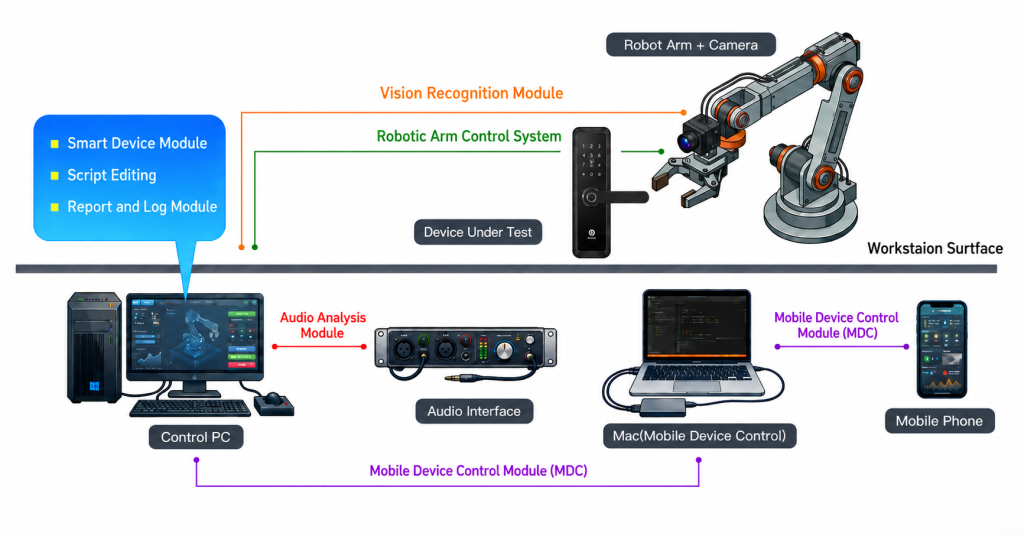
Hardware + Software × Instrument Integration: The Seven Core Modules of the Allion AI Robotic Test Platform (ART)
Core Module
What It Does
Robotic Arm
Uses high-precision robotic arms to simulate real user operations on buttons, dials, menus, and touchscreens, ensuring every test action is highly repeatable and precise.
Smart Wizard
A No-Code, visual workflow — “select action → capture screenshot → select target → robotic arm pre-test ” — is all it takes to build a test. Image-Swap technology lets different models reuse the same script without rewriting, and AI Semantic Recognition lets testers simply type text to automatically locate the target.
Script Editor
Robotic arm actions are fully modularized, so users can quickly combine arm actions, device operations, and system parameters to build a complete test case — no additional coding required.
AI Visual Recognition
Compares the captured image against a database to identify objects, icons, or text and trigger the corresponding response — well suited to long-duration monitoring and high-speed screen recognition on camera interfaces and menus.
Audio Analysis
Covers sound-quality checks for notification tones and operational sound effects, helping identify audio-related anomalies.
Mobile Device Control (MDC)
Uses a device control service to realistically simulate App connectivity and remote-control operations (supports both Android and iOS).
Report & Log
Automatically records the complete execution history during testing and generates a visual test reports with complete cross-system compatibility — including test screenshots, key audio recordings, and detailed logs — ensuring 100% traceability of every test.
Why Choose Allion: Faster. Easier. Better
Faster
Environment, equipment, and team are all ready to go. With 24/7 automated execution and fast changeover across models and product lines, testing can start right away.
Easier
No-Code operation combined with AI interpretation, paired with standardized fixtures for fast deployment. Tasks that took manual testers a long time — or that they couldn’t do at all — are already over 70% automated.
Better
Replaces subjective human eyes and ears with objective, quantifiable recognition rates. Unlike manual testing, which is prone to fatigue and missed defects, ART runs consistently and checks every item without fail.
Your Trusted Long-Term Quality Partner From Precision Debugging to Comprehensive Technical Empowerment
Issue Analysis & Debugging Consultancy
We don’t just detect problems — we use logs, screenshots, audio recordings, and traces to precisely pinpoint issues and perform Root Cause Analysis (RCA).
We provide recommendations and priority guidance, and transfer our methodology to empower your R&D team.
Ecosystem Extension Partner
With environment, equipment, personnel, and solutions all in place, we serve as your long-term validation partner — not a one-time transaction.
The more your product lineup grows and revisions accelerate, the more you need stable QA capacity — we fill that gap and grow with you long-term.
Onboarding Process:
Four Stages to Get Started Quickly
Phase 01 Evaluation
Allion’s professional team provides a complimentary on-site assessment.
Phase 02 Installation
High-efficiency shipping, hardware installation, and system integration.
Phase 03 Acceptance
Rigorous acceptance testing, with the warranty activating immediately upon sign-off.
Phase 04 Training
16 hours of comprehensive training provided to ensure test personnel seamlessly transition and get up to speed.
Ready to See It in Action? Book Your Demo or PoC Today!
Seeing is believing. Experience our No-Code test recording and automated evaluation workflow on your own products—from camera functionality and peripheral interaction validation to smart locks, refrigerators, smart speakers, and kiosk systems—while our experts provide standardized implementation recommendations tailored to your UI layout and testing needs.
About the Allion AI Robotic Test Platform (ART) | FAQ
A turnkey automated validation platform that integrates a collaborative robotic arm, AI vision, and physical fixtures. It covers automotive, imaging electronics, and production-line applications, offering a one-stop service ranging from third-party lab testing to full hardware/software test rig deployment.
Not at all. Allion ART uses a No-Code visual architecture, enabling 100% script reuse:
(1) UI/Firmware Updates (Image-Swap): Simply replace the reference image to reuse the existing logic.
(2) Cross-Language Testing (AI Semantic Recognition): Supports typing text instead of taking screenshots — AI automatically locates the target element, ensuring precise execution even when switching between multi-language interfaces.
Very easy. Allion ART provides a No-Code visual interface and Smart Wizard guidance — testers can build a complete script through a simple visual workflow: “select the area on screen → set tap/swipe/capture” — no coding required.
ART goes beyond simply catching defects—it acts as an “Issue Analysis & Debugging Consultant.” During testing, the system automatically captures complete logs, screenshots, audio files, and trace records in real time. This enables teams to pinpoint the exact moment and root cause of anomalies, while providing actionable resolution insights and fix priorities to empower your R&D team.
By combining AI Vision with OCR technology, ART automatically recognizes on-screen elements, button positions, and text content, and coordinates with the robotic arm to perform precise operations. Even after a UI change, recognition baselines can be quickly re-established.
Using modular automated scripts, ART automatically triggers Critical User Journey (CUJ) testing after every firmware/OTA update. It performs a comprehensive suite of cross-version compatibility and regression tests, delivering actionable reports within days to ensure full stability across your connected ecosystem.
ART provides a complete solution covering both physical device operation and the full connectivity/data-transfer experience. Beyond physical operation, its Mobile Device Control (MDC) module automates validation of Wi-Fi image transfer, Bluetooth pairing, App connectivity/remote control, and cloud upload and sharing — eliminating the need to work with multiple vendors for separate testing.
Traditional software automation tools typically require installing an agent or SDK, or modifying code, on the device under test (DUT) to simulate user actions — which often isn’t possible on finished mass-production products or when customers don’t grant system-level access. ART instead performs genuine physical operations via a collaborative robotic arm and AI vision, directly simulating how a user presses buttons, touches the screen, or turns a knob — with no need to access the DUT’s internal system. This also lets ART validate hardware-level factors that software logic alone can’t reach, such as physical button feel and mechanical durability.
Fill it in and talk to our most experienced experts Leave your details and ask us anything!
Allion uses cookies and shares data with Google Ads and LinkedIn for analytics and ads. Data is retained up to 6 months. See our Privacy Policy for details. Do you consent?AcceptDecline