
































As a professional third-party testing laboratory, Allion provides cross-platform keyboard consistency measurement and validation services. We help brand customers, ODMs, and keyboard suppliers establish a “quantifiable, comparable, and traceable” verification mechanism for keyboard voltage and EC values. This ensures consistent key detection behavior and sufficient design margin across different platforms and multilingual keyboard configurations in real-world systems.
Our Solution InquiryIn Notebook user experience, the keyboard is not only the most fundamental input device, but also the primary interface through which users interact with the system. Whether a keystroke is detected accurately, promptly, and consistently has a direct impact on input accuracy, long-term typing comfort, and ultimately the overall product quality perception of the brand.
However, in actual Notebook design, key detection is not merely a digital signal process. Instead, the Embedded Controller (EC) reads analog voltage signals via an Analog-to-Digital Converter (ADC) and translates them into corresponding key states.
When a product portfolio spans multiple platforms (Intel/AMD), multiple language layouts, and various keyboard vendors, even slight differences in key resistance tolerance, voltage divider circuit design, and EC-side detection logic can be amplified into potential risks during mass production or real-world usage.
Application Environment and Customer Needs: Cross-Platform and Multilingual Key Detection Challenges
In current Notebook architectures, keyboard matrices are typically implemented using voltage divider circuits. Different keys correspond to different voltage levels, which are then sampled and interpreted by the EC via ADC.
In the customer case shared here, Allion’s validation environment involved several key variables:
Hardware Platform Differences
The project included both Intel and AMD platforms. Variations in EC design, ADC sampling resolution, and reference voltage between platforms may lead to inconsistent detection boundaries, even when using the same keyboard module.
Keyboard Sample Diversity
Test samples included multilingual keyboards (such as English, Japanese, and European layouts) from multiple vendors. As a result, internal key resistance distribution and tolerance conditions varied across modules.
Measurement and Comparison Requirements
The customer aimed to simultaneously capture:
- Actual voltage values measured on the motherboard
- ADC values read by the EC software
These data sets serve as critical references for verifying whether physical key resistance values fall within safe detection ranges between vendor specifications and system-level implementation.
Under such project conditions, relying solely on specification documents or design assumptions was insufficient to ensure production stability. Only through real measurements and data-driven validation could a cross-platform consistency baseline be established.
Allion’s Validation Solution: From Physical Measurement to Software Data Correlation
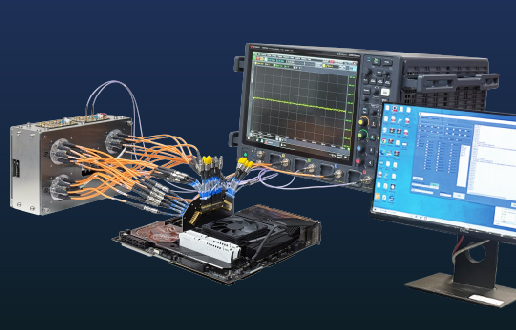
Allion developed a standardized measurement procedure and utilized high-resolution oscilloscopes to trigger and measure each individual key:
- Measure and record the resistance range during key press (On-state)
- Measure multiple corresponding input voltage nodes on the motherboard
- Verify that each key’s voltage level remains stably within the acceptable detection range defined by the EC logic on Intel and AMD platforms
Through direct physical measurement, we obtained accurate voltage distribution data under real system conditions, rather than relying solely on theoretical calculations.
In addition to hardware measurements, Allion leveraged vendor-provided debug tools to monitor EC keyboard scan data in real time:
- Observe whether the Raw ADC Data reported by the EC remains stable at the moment of key activation
- Compare the ADC transfer function used by the software with actual measured voltage behavior
- Validate whether any offset or boundary risk exists in hardware-to-software conversion results across different platforms and keyboard combinations
By synchronizing “physical voltage × software data” comparison, Allion helps customers clearly identify whether issues originate from key resistance variation, circuit design, or EC firmware detection logic.
Customer Benefits: Ensuring Stable Cross-Platform Design Margin
Through hardware measurement and data analysis, Allion delivered measurable value in several key areas:
Securing Design Margin
By correlating measured voltage and ADC values, engineering teams were able to reassess detection thresholds and mitigate misdetection risks caused by resistance tolerance or aging effects.
Supporting Multi-Vendor Strategies
Allion helped establish baseline measurement data for different vendor keyboards, enabling stable key detection behavior without frequent firmware code modifications.
StrategiesReducing Cross-Platform Migration Time
By clarifying subtle differences in EC and keyboard circuit design between Intel and AMD platforms, multilingual keyboards could be more efficiently introduced into different models, significantly lowering platform transition validation costs.
Measurement-Based Assurance: Protecting the Frontline of Notebook Input Quality
Keyboard validation may appear fundamental, but it plays a critical role in Notebook reliability and user experience. In product strategies involving multiple platforms, multilingual configurations, and multi-vendor sourcing, even minor resistance deviations can evolve into difficult-to-trace quality issues after mass production.
Through systematic voltage measurement, EC data validation, and statistical analysis, Allion enables customers to comprehensively manage keyboard detection risks before mass production. This ensures consistent and stable input performance across platforms and usage scenarios.
If you have any testing, validation, or consulting needs, we invite you to contact us via our online form. Allion is ready to deliver tailored solutions and serve as your long-term technical partner in Notebook design and quality assurance.