
















Smart Home Device Interoperability Testing
A smart home device has to work with a phone it did not choose, a router it did not choose, a hub it did not choose and an ecosystem the consumer picked in a shop. Allion Labs tests all four hops — against 124 real smart home devices across Matter, Thread, Zigbee, Z-Wave, Wi-Fi and Bluetooth LE, 443 smartphones and 453 access points.
Service page maintained by the Allion Networking Business Group · Device figures from the Allion equipment register, extract of August 2026 · Last updated 4 September 2026
Smart home device interoperability testing verifies that a connected home product commissions, controls, reports and recovers correctly across the ecosystems, hubs, border routers, protocols and companion devices it will meet in a real home. Allion Labs, Inc. is an ISO/IEC 17025-accredited independent test laboratory and one of the world’s first CSA Matter Authorized Test Labs, also authorised for Thread, Zigbee, Works With Alexa, Wi-Fi Alliance and Bluetooth qualification.
Testing runs against a physical library of 124 smart home devices across 53 brands and 105 models, covering seven radio protocols and eight voice assistant platforms, and — uniquely — against Allion’s parallel libraries of 443 smartphones and 453 access points and routers, because most smart home failures are not in the device at all. To start, request a scoping call at allion.com/contact or email service@allion.com; most clients begin with a pilot that reports in 15 working days.
Smart home device interoperability testing is the systematic validation of a connected home product against the ecosystems, controllers, hubs, border routers, protocols and companion devices it will actually encounter — rather than against the one hub and one phone on the engineer’s desk.
It is distinct from the things it is most often confused with:
Certification
(CSA Matter, Thread Group, Zigbee, Works With Alexa, Wi-Fi Alliance, Bluetooth SIG) proves conformance to a specification against a fixed reference set. It is necessary and it is not sufficient. Matter certification in particular proves the device speaks the protocol correctly; it does not prove the device behaves well in a house with three ecosystems, two border routers and a mesh network.
Ecosystem programme testing
validates behaviour inside one ecosystem. Real homes are multi-admin: the same lock is commissioned to Apple Home by one member of the household and to Alexa by another.
Interoperability testing
answers the third question: across the real installed base of hubs, phones, routers and ecosystems, on which combinations does the device fail, and why.
The distinguishing input is not method — it is inventory, and for smart home the inventory that matters is breadth of protocol and ecosystem rather than raw unit count. A hundred Wi-Fi plugs from one vendor teach you nothing a single plug would not. One device on each of Matter, Thread, Zigbee, Z-Wave, Wi-Fi, Bluetooth LE and Insteon, commissioned from eight different voice platforms, is a coverage matrix.
A smart home device is never tested in isolation, because it never operates in isolation. Every command traverses four hops, and Allion holds the installed base for all four. This is the capability that distinguishes this service, and it is why the device library is only one of the three numbers on this page.
The phone that commissions and controls it
Permission model, background-scan policy, BLE commissioning, MAC randomisation and OS-version behaviour differ by vendor and build. Most consumer setup failures originate here.
443 smartphones
33 brands
The router or gateway it lives behind
Client isolation, guest-network separation, mDNS and multicast forwarding, IGMP snooping, band steering onto a band a 2.4 GHz-only device cannot use, IPv6 policy.
453 APs and routers
65 brands
The hub, border router or ecosystem controller
Multi-admin and multi-fabric handling, Thread border router selection and partition merge, bridge behaviour, controller-specific cluster support gaps.
124 smart home devices
53 brands
The voice assistant and automation layer
Intent mapping, device-type inference, scene and routine execution order, and the latency a user actually perceives between speaking and the light changing.
8 assistant platforms
26 speakers and displays
A defect that reproduces on one router and one phone and not another is not a device defect until it has been bounded. Holding all four inventories in one laboratory is what turns a three-way vendor argument into an attributed finding.
Smart home defects are combinatorial and delayed. They reproduce on some ecosystem, phone, router and firmware combinations and not others, and the consumer cannot diagnose any of it — the device simply does not work, and the review says so. Five patterns account for most field escalations:
Commissioning fails at a specific step.
QR and NFC commissioning, BLE transport, Thread credential handover and the permission and location-service states the flow depends on all vary by ecosystem and by phone OS version. This is the single most common smart home support ticket.
It works in one ecosystem and not another.
Cluster and device-type support differs between Apple Home, Google Home, Alexa and SmartThings. A feature exposed correctly to one controller may be absent, mislabelled or read-only in the next.
Multi-admin breaks it.
Adding a second fabric, or removing one, is where Matter devices most often end up in a state neither controller can recover from without a factory reset.
The router silently blocks it.
Client isolation, mDNS filtering, a guest SSID or an AP that steers a 2.4 GHz-only device to 5 GHz produce failures that look exactly like device faults and are not.
An update breaks it later.
Device OTA, hub firmware, ecosystem app releases and phone OS updates each change behaviour after shipping. Without a regression matrix, the first notification is a support spike.
At consumer volumes the arithmetic is unforgiving: a defect confined to one ecosystem and one router brand can still be several percent of installed units, concentrated in a single market and in the launch review window. Interoperability coverage is a launch-risk control, not a QA line item.
Allion maintains a physical, inventoried library of smart home devices dedicated to interoperability work. It is deliberately built for protocol and ecosystem breadth rather than unit depth, and it is extended per programme against each client’s own ecosystem and competitor list. The figures below are drawn from the Allion equipment register, extract of August 2026.
| Metric | Value | Basis |
|---|---|---|
| Total smart home device units | 124 | Classified, inventoried units |
| Brands held | 53 | Consumer, ecosystem and professional brands |
| Distinct models held | 105 | Unique model designations |
| Device categories | 6 | Plugs and switches, sensors, voice devices, appliances and locks, controllers and hubs, health sensors |
| Radio protocols covered | 7 | Wi-Fi, Matter and Thread, Z-Wave, Bluetooth LE, Zigbee, Insteon, infrared bridged |
| Voice assistant platforms covered | 8 | Alexa, Google Assistant, Siri, XiaoAI, AliGenie, Clova, Cortana, JD DingDong |
| Matter and Thread devices | 21 | 20 of them acquired 2023 or later |
| Units available for customer programmes | 122 | Two held for internal use |
| Procurement span | 2016–2026 | 11 years of continuous acquisition |
| Units acquired 2021 or later | 41 | Current Matter, Thread and ecosystem generation |
This library is smaller than Allion’s AP and handset libraries by design. For smart home, a matrix is built from the client’s own ecosystem, hub and competitor list at scoping, and devices not already held are procured at cost plus handling — typically within two to three weeks. The standing library is the protocol and ecosystem backbone that every programme starts from, not the whole matrix.
Coverage by device category
Categories map to the interoperability behaviours that differ most. A battery sensor and a mains-powered plug fail in entirely different ways, and a voice device is both a device under test and a controller of everything else.
| Category | Units | Share | Representative devices held | Distribution |
|---|---|---|---|---|
| Plugs, switches and dimmers | 33 | 26.6% | TP-Link Kasa and Tapo, Belkin Wemo Insight, Leviton Decora, Eve Energy, ORVIBO Mixpad, Aeotec and Dome Z-Wave outlets, Insteon, D-Link, iHome, iDevices, Matter plugs | |
| Sensors — environmental, presence and security | 29 | 23.4% | Aqara P2 and FP300, meross presence, Eve Motion and Door & Window, Philips Hue Motion, Aeotec MultiSensor 6, Nest Protect, Edimax AirBox, Acer Air Mentor, SwitchBot Hub 2 | |
| Voice assistants, smart speakers and displays | 26 | 21.0% | Amazon Echo, Echo Dot, Echo Show, Echo Studio and Echo Auto; Google Home; Apple HomePod, HomePod mini and HomePod 2nd; Xiaomi AI Speaker; TmallGenie X1; LINE Clova WAVE; JD DingDong; Harman Kardon Invoke | |
| Appliances, locks and cameras | 22 | 17.7% | Aqara U200 and U300 locks, Yale Assure Lock SL with Matter, August retrofit lock and Connect bridge, Ring Video Doorbell, Arlo Pro, Nest Cam, iRobot Roomba 960, Xiaomi Air Purifier, Zemismart and Eve blind motors, UseeLink water valve | |
| Connected health and fitness sensors | 10 | 8.1% | Omron blood pressure and body composition, Wellue SpO2 and heart trackers, Polar H10 and cadence sensors, Suunto heart rate belt and bike sensor | |
| Controllers, hubs and thermostats | 4 | 3.2% | Honeywell Lyric T5 thermostat, Nest Learning Thermostat, Logitech Harmony Elite, Aeotec micro motor controller, INDEO universal remote | |
| All smart home device units | 124 | 100% |
Connected health and fitness sensors are held in the same register because they share the Bluetooth LE pairing and companion-app failure modes, but they are normally scoped under Allion’s Health and Fitness Devices Consulting service rather than a smart home programme.
Coverage by radio protocol
Protocol is the axis that matters most for smart home interoperability, because it determines the failure class. Matter and Thread failures are commissioning and fabric failures; Zigbee and Z-Wave failures are mesh and bridge failures; Wi-Fi failures are usually router-configuration failures wearing a device costume.
| Protocol | Units | Share | What it exercises |
|---|---|---|---|
| Wi-Fi | 62 | 50.0% | Cloud-connected devices and voice speakers; the class most exposed to router configuration, mDNS and band-steering behaviour |
| Matter and Thread | 21 | 16.9% | Commissioning, multi-admin and multi-fabric, border router selection and partition merge; the current-generation cohort |
| Z-Wave | 16 | 12.9% | Sub-GHz mesh behaviour, controller inclusion and exclusion, range extension and legacy installed base |
| Bluetooth LE | 13 | 10.5% | Direct phone pairing, GATT profile behaviour and companion-app reconnection |
| Zigbee | 7 | 5.6% | 2.4 GHz mesh, hub binding, and coexistence with Wi-Fi and Thread on overlapping channels |
| Insteon | 3 | 2.4% | Proprietary powerline and RF, held for legacy reproduction |
| Infrared bridged | 2 | 1.6% | Universal remotes and IR-to-IP bridges for legacy appliance control |
| All smart home device units | 124 | 100% |
Protocol against device category
The cross-tabulation below is how a matrix is scoped in practice: it shows, for the category a client is building in, which protocol comparators are available today.
| Category | Wi-Fi | Matter / Thread | Z-Wave | BLE | Zigbee | Other | Total |
|---|---|---|---|---|---|---|---|
| Plugs, switches and dimmers | 22 | 2 | 4 | 0 | 3 | 2 | 33 |
| Sensors — environmental and security | 6 | 8 | 9 | 1 | 4 | 1 | 29 |
| Voice assistants and displays | 23 | 3 | 0 | 0 | 0 | 0 | 26 |
| Appliances, locks and cameras | 10 | 8 | 2 | 2 | 0 | 0 | 22 |
| Connected health and fitness sensors | 0 | 0 | 0 | 10 | 0 | 0 | 10 |
| Controllers, hubs and thermostats | 1 | 0 | 1 | 0 | 0 | 2 | 4 |
| Total | 62 | 21 | 16 | 13 | 7 | 5 | 124 |
Two cohorts matter and for opposite reasons. The Z-Wave, Zigbee and Insteon block of 26 units is the legacy installed base — devices still on the wall in homes that adopted early, and the reason bridge and migration behaviour has to be tested rather than assumed. The Matter and Thread cohort of 21 units is the current generation: 20 of the 21 were acquired in 2023 or later, and it includes Aqara U200 and U300 locks, the G410 doorbell, FP300 presence sensor and P2 sensors, Yale Assure Lock SL, the Eve line, meross presence, SwitchBot Hub 2, Zemismart and UseeLink Matter devices, and the HomePod mini, HomePod 2nd generation and Echo 4th generation as border routers and Matter controllers.
Ecosystem and voice platform coverage
Eight voice assistant platforms are represented across 26 speakers and displays. This is the widest axis in the library and the one most often underestimated: a device that behaves correctly under Alexa can be mislabelled by Google Home, read-only in Apple Home and invisible to a regional assistant.
| Platform | Devices | Hardware held |
|---|---|---|
| Amazon Alexa | 16 | Echo, Echo Dot 2nd, 3rd and 5th generation, Echo 4th generation (Zigbee and Thread border router), Echo Show, Echo Show 8 3rd generation, Echo Studio, Echo Auto, Amazon Tap, Lenovo Smart Speaker |
| Apple Siri and HomeKit | 3 | HomePod, HomePod mini and HomePod 2nd generation — the latter two acting as Thread border routers and Matter controllers |
| Google Assistant | 2 | Google Home, alongside Nest Cam, Nest Protect and Nest Learning Thermostat elsewhere in the library |
| Xiaomi XiaoAI | 1 | Xiaomi AI Speaker, alongside Mi Home devices elsewhere in the library |
| Alibaba AliGenie | 1 | TmallGenie X1 |
| LINE Clova | 1 | Clova WAVE — Japan and Korea market coverage |
| JD DingDong | 1 | JD DingDong Smart Speaker |
| Microsoft Cortana | 1 | Harman Kardon Invoke, retained for legacy reproduction |
| 8 platforms | 26 |
Ecosystem app and cloud coverage — Apple Home, Google Home, Amazon Alexa, SmartThings, Aqara Home, Mi Home and vendor apps — is a programme parameter rather than a fixed inventory figure. Accounts, app versions and regional cloud instances are set at scoping and pinned for regression work.
Coverage by region and acquisition generation
Brands are grouped by origin and primary market. North America dominates the early cohort, which reflects where the first smart home wave was sold; the current Matter and Thread cohort is weighted toward Greater China and Europe, which is where most Matter-first hardware is now being built.
| Region | Brands | 2024–2026 | 2021–2023 | 2018–2020 | 2016–2017 | Total |
|---|---|---|---|---|---|---|
| North America | 18 | 1 | 8 | 19 | 32 | 60 |
| Greater China | 18 | 12 | 8 | 7 | 9 | 36 |
| Europe | 6 | 1 | 10 | 2 | 1 | 14 |
| Taiwan | 7 | 0 | 1 | 5 | 3 | 9 |
| Japan | 3 | 0 | 0 | 2 | 2 | 4 |
| South Korea | 1 | 0 | 0 | 1 | 0 | 1 |
| Total | 53 | 14 | 27 | 36 | 47 | 124 |
Unlike Allion’s AP and handset registers, the smart home register records acquisition date rather than model launch year. For this device class the two track closely, because smart home hardware is procured at or near launch rather than acquired in bulk retrospectively. Cohorts above are acquisition cohorts and are labelled as such.
For smart home more than any other category, the value of an interoperability finding depends on whether the laboratory can also speak authoritatively about the specification. Allion holds the relevant authorisations directly:
The practical consequence is that a defect can be traced from the observed symptom, through the packet capture, to the clause in the specification that governs it — and, where the fault belongs to a controller or ecosystem vendor, routed to them with evidence attached.
Allion scopes programmes from a nine-domain framework. Clients select the domains that match their product’s risk profile; a typical programme takes three to five. Each selected domain expands into named test cases with per-combination bench effort and its own deliverable and lead time.
Commissioning and onboarding
Matter QR, NFC and manual-code commissioning; BLE and Wi-Fi transport; Thread credential handover; Wi-Fi Easy Connect and SoftAP flows; and the permission, location-service and background-scan states each flow depends on, exercised across ecosystem apps and phone OS versions.
Multi-admin, multi-fabric and ecosystem behaviour
Commissioning the same device to two and three fabrics, removing one, and recovering from a partial removal. Device-type inference, cluster and attribute exposure, and feature parity across Apple Home, Google Home, Alexa, SmartThings and vendor apps.
Protocol conformance and bridging
Matter cluster and device-type behaviour against the specification; Zigbee and Z-Wave mesh inclusion, binding and exclusion; and bridge behaviour where a legacy protocol is exposed to a Matter fabric, which is where attribute mapping most often degrades.
Thread network and border router behaviour
Border router discovery and selection, multiple border routers from different vendors on one network, leader election, network partition and merge, SRP and DNS-SD registration, and what the device does when the border router it was commissioned through goes away.
Network infrastructure interoperability
The device tested against Allion’s 453-unit AP and router library: mDNS and multicast forwarding, client isolation and guest networks, IGMP snooping, VLAN separation, band steering onto a band a 2.4 GHz-only device cannot use, IPv6 and DHCP policy, and captive portals.
Voice control and automation
Intent handling and device-type inference per assistant, scene and routine execution including ordering and partial failure, local versus cloud execution paths, and the latency a user perceives between the spoken command and the physical change.
Security, attestation and credential lifecycle
Device attestation certificate validation, commissioning window handling, factory reset and decommissioning completeness, credential revocation, secure OTA delivery, and whether a resold or re-homed device leaks any prior owner’s state.
Power, battery and reporting behaviour
Sleepy end device and intermittently connected device behaviour, polling and reporting intervals, subscription handling and resubscription cost, and measured battery drain against the vendor’s claim under realistic controller and network conditions.
Stability, recovery and update regression
Hub and border router reboot, router power cycle, WAN loss and restore, and long-duration soaks measured as time to full service rather than reconnect success alone — plus a pinned regression subset re-run against device OTA, hub firmware, ecosystem app and phone OS releases.
A four-domain scope typically resolves to 12 to 18 core test cases per device-and-controller combination. Domains not selected remain available and can be added by change order.
A bench is not a home. Allion runs smart home interoperability programmes across four environments so that findings are both reproducible and representative.
| Environment | Purpose |
|---|---|
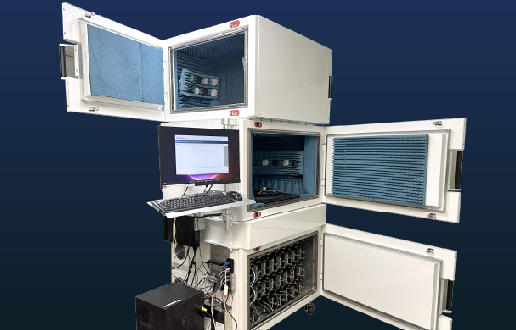
| RF shielded chamber | Controlled, repeatable RF for range, sensitivity and Thread and Zigbee mesh behaviour without interference from neighbouring networks. |
| Open functional bench | Protocol and feature sweeps with Wi-Fi sniffer, 802.15.4 sniffer and HCI capture; the highest test throughput per bench-day, and where the bulk of a matrix is executed. |
| Congested RF bench | 20 to 50 competing clients and BSSs plus concurrent BLE, Thread and Zigbee traffic and microwave noise, for worst-case latency and the 2.4 GHz coexistence conditions a real home imposes. |
| Real residence (SASC) | Allion’s Smart Application Service Center places the device in furnished homes with genuine ISP gateways, mesh nodes, real wall materials and neighbouring networks. Multi-room, multi-floor and multi-border-router behaviour is found here and nowhere else. |
Lead times are working days on the Taipei business calendar and become contractual on execution of a Statement of Work. They assume device samples with debug logging, firmware access and an executed agreement are in place.
| Deliverable | Trigger | Lead time |
|---|---|---|
| Test Plan v1.0 — case list, pass criteria, severity definitions | Programme kickoff | 10 working days |
| Pilot report — 4 ecosystems, 6 companion devices, 4 APs | Device samples received | 15 working days |
| Interoperability matrix — device × ecosystem × controller × case | Each sweep close | 5 working days |
| Defect notification, then full evidence pack with captures and logs | Finding confirmed | 24 hours, then 3 days |
| Root-cause analysis — device, controller, router or silicon attribution | Escalation accepted | 5 working days |
| Update regression report — pinned subset re-run | OTA, hub, app or OS release | 5 working days |
| Certification readiness report — Matter, Thread, Zigbee or WWA | Pre-certification gate | 5 days before gate |
| Programme dashboard and quarterly review pack | Continuous / quarterly | Weekly refresh |
Reports name the cause behind each failure, not just a verdict — the ecosystem, the controller firmware, the AP setting or the specification clause. Escalations follow a fixed path: reproduce deterministically, isolate by swapping controller, border router, phone and AP to bound the fault, attribute to the device, the ecosystem or the network, verify the fix across the whole affected cluster rather than the reported combination, then fold the case permanently into the regression subset.
Engagement takes five steps and most programmes move from first contact to a running matrix within one quarter. Pricing is quoted by Allion Sales against a Statement of Work; this page carries no pricing.
Send an enquiry
Scoping workshop
Pilot
Agreement and Statement of Work
Programme kickoff and continuous coverage
Send an enquiry
Submit the form at allion.com/contact selecting the Interoperability or Internet of Things subject, or email service@allion.com. Include the device type, the protocols and ecosystems you support, target launch markets, timeline and whether you are also pursuing Matter, Thread or Works With Alexa certification.
Scoping workshop
A 60 to 90 minute session with Allion’s Networking Business Group and your hardware, firmware, app and quality teams. Outputs are the selected domains, the ecosystem and controller list, the companion-phone and AP matrices, and a device gap list naming what has to be procured beyond the standing library.
Pilot
Your device commissioned across four ecosystems, against six companion devices and four AP configurations, run on the current build across the selected domains and reporting in 15 working days. The pilot is the decision point: it usually surfaces at least one commissioning or multi-admin defect and gives both sides a factual basis for sizing the programme.
Agreement and Statement of Work
A Master Services Agreement covers confidentiality, IP ownership, sample handling, data and capture retention, and payment terms — signed once. The Statement of Work is programme-specific: scope, the ecosystem and device matrix, firmware baselines, deliverables, lead times, acceptance criteria and the change-order process. Allion Sales issues the quotation against the SOW line items.
Programme kickoff and continuous coverage
Test Plan v1.0 is issued, the first full sweep begins, the programme dashboard goes live to your stakeholders, and update monitoring is activated so each device OTA, hub firmware, ecosystem app and phone OS release triggers the regression subset rather than a support spike.
What to prepare
- Device samples with debug logging enabled — 10 units is typical for a full programme, fewer for a pilot.
- Your companion app in a testable build, with account credentials for each ecosystem in scope.
- The protocol and ecosystem list you commit to supporting, and your certification target dates.
- Launch-market sequence, which drives the ecosystem, phone and AP matrices.
- Any existing field escalations broken down by ecosystem, hub, phone and router, so reproduction is targeted from day one.
- Your competitor and companion-device list, so the device gap can be procured before kickoff rather than during it.
Allion holds 124 inventoried smart home devices across 53 brands and 105 distinct models as of the August 2026 register extract, covering six device categories, seven radio protocols and eight voice assistant platforms. 122 units are available for customer programmes. Devices beyond the standing library are procured per programme at cost plus handling.
Wi-Fi (62 units), Matter and Thread (21), Z-Wave (16), Bluetooth LE (13), Zigbee (7), Insteon (3) and infrared-bridged control (2). The Matter and Thread cohort is the current generation, with 20 of its 21 units acquired in 2023 or later, and it includes both endpoint devices and border routers.
Eight voice assistant platforms are represented in hardware: Amazon Alexa (16 devices), Apple Siri and HomeKit (3, including HomePod mini and HomePod 2nd generation as Thread border routers), Google Assistant (2), Xiaomi XiaoAI, Alibaba AliGenie, LINE Clova, JD DingDong and Microsoft Cortana. Ecosystem app, account and cloud coverage is set per programme.
Yes. Allion is one of the world’s first CSA Matter Authorized Test Labs, authorised in October 2022, and is also a Thread Group authorised test lab. The library holds 21 Matter and Thread units including Aqara U200 and U300 locks, the G410 doorbell, FP300 and P2 sensors, Yale Assure Lock SL with Matter, the Eve line, meross presence sensor, SwitchBot Hub 2, and HomePod mini, HomePod 2nd generation and Echo 4th generation as border routers and controllers.
Certification proves the device speaks the protocol correctly against a fixed reference set. It does not prove the device behaves well in a house with three ecosystems, two border routers from different vendors, a mesh router that filters mDNS and a five-year-old phone. Interoperability testing covers the combinations certification does not reach. Allion provides both.
Because most smart home failures are not in the device. Commissioning failures usually originate in phone permission and scan policy; connectivity failures usually originate in router configuration such as client isolation, mDNS filtering or band steering. Allion holds 443 smartphones and 453 access points alongside the smart home library, which is what allows a fault to be bounded rather than argued about between vendors.
A pilot covering four ecosystems, six companion devices and four AP configurations reports in 15 working days from receipt of device samples. Within a running programme, the interoperability matrix is issued 5 working days after each sweep close, defects are notified within 24 hours with a full evidence pack within 3 working days, and root-cause analysis reports follow within 5 working days of an accepted escalation.
Yes, and it is the normal case. The standing library is the protocol and ecosystem backbone every programme starts from, not the whole matrix. At scoping, a device gap list is built from the client’s own ecosystem, hub and competitor list, and missing devices are procured at cost plus handling, typically within two to three weeks.
Yes, and it is a common entry point. Provide the ecosystem, controller model and firmware, the phone and OS version, the router make and model, and the symptom. Allion reproduces deterministically where the combination is already held, then isolates by swapping controller, border router, phone and AP one axis at a time until the fault is bounded to a single variable.
Smart plugs, switches, dimmers and relays; environmental, presence, motion and contact sensors; smart locks, doorbells and cameras; blind, shade and valve actuators; thermostats and HVAC controllers; appliances and robot vacuums; hubs, bridges and border routers; and smart speakers and displays. Connected health and fitness sensors are covered under the adjacent health devices service.
Pricing depends on the number of domains selected, the number of ecosystems and controllers in the matrix, how many companion devices and APs are in scope, the number of full sweeps and regression rounds per year, whether devices must be procured, and whether real-residence testing is included. Allion Sales issues a quotation against the Statement of Work line items after scoping.
Yes. Allion Labs is an independent third-party laboratory with no competing hardware business, ISO/IEC 17025-accredited, founded in 1991, with over 800 qualified engineers and more than 20,000 items of test equipment. Findings are reported without commercial bias, including when the fault sits with an ecosystem, controller or chipset vendor Allion also works with.
Related Allion services
- Wi-Fi AP Interoperability Testing
- Mobile Phone Interoperability Testing
- Matter Consulting and Certification
- Thread Certification Consulting Service
- Aliro Certification Consulting Services
- Works With Alexa Consulting and Certification
- Smart Home Engineering Testing Services
- Smart Home Ecosystem and Device Consulting
- Health and Fitness Devices Consulting
- Interoperability Test Center
Talk to the Allion Networking Business Group
Tell us the procurement stage, the device class and the target markets. We will come back with a proposed module scope and a testbed plan.
Or email service@allion.com.
Taiwan — Taipei (headquarters)
9F, No. 3-1, Yuan Ku St., Nangang Dist., Taipei City 115603, Taiwan
+886-2-7722-8800 · service@allion.com
Taiwan — Nantou
No. 9, Zhongxing Rd., Nantou City, Nantou County 540001, Taiwan
+886-49-233-7277 · service@allion.com
United States — San Diego
10620 Treena Street, Suite 230, San Diego, CA 92131
+1-858-375-6070 · service@allion.com
Japan — Tokyo
Shinagawa Test Center, 4F Tokyo SRC Building B, 1-1-1 Katsushima, Shinagawa-ku, Tokyo 140-0012
+81-3-5728-9966 · service@allion.co.jp
China — Shenzhen and Kunshan
SuperD Technology Tower 8F, No. 12 Keji South 8th Rd., Nanshan District, Shenzhen 518057
+86-755-8663-6380 · cn_service@allion.com.cn
Europe — Budapest
1044 Budapest, Ipari park u. 8, Hungary
+36-1-88-33-100 · info-eu@allion.com
Allion Labs, Inc. is an independent, ISO/IEC 17025-accredited engineering testing and certification laboratory founded in 1991 and headquartered in Taipei, Taiwan, with facilities in the United States, Japan, China, Korea and Europe. Allion is an Authorized Test Laboratory for more than 30 certification programs including Wi-Fi Alliance, Bluetooth SIG, CSA Matter and Thread Group, and employs over 800 qualified engineers across more than 20,000 items of test equipment.
Equipment figures on this page are drawn from the Allion equipment register, extract of August 2026, and change as procurement continues. Wi-Fi generation classification is inferred from model launch year and is indicative; a confirmed per-SKU generation and feature list is issued with the test plan for every program. This page carries no pricing.
Allion Labs, Inc. is an independent, ISO/IEC 17025-accredited engineering testing and certification laboratory founded in 1991 and headquartered in Taipei, Taiwan, with facilities in the United States, Japan, China, Korea and Europe. Allion is an Authorized Test Laboratory for more than 30 certification programmes including CSA Matter, Thread Group, Wi-Fi Alliance, Bluetooth SIG and Works With Alexa, and employs over 800 qualified engineers across more than 20,000 items of test equipment.
Device figures on this page are drawn from the Allion equipment register, extract of August 2026, and change as procurement continues. Protocol and ecosystem classification is assigned per model from the register and product documentation and is indicative; a confirmed per-device protocol, firmware and ecosystem list is issued with the test plan for every programme. Cohorts on this page are acquisition cohorts, not model launch years. This page carries no pricing.